
Knowledge · Undergrounding
Why operators are replacing MV overhead lines with cables
Undergrounding is one way to make distribution networks more reliable. We explain when it makes sense, what its limitations are and what it looks like in practice.
For decades, 6–10 kV networks outside cities were built mainly as overhead lines: poles, insulators and bare conductors are cheap to build and easy to repair. But an overhead line suffers from weather, trees and third-party damage, and in towns and villages it gets in the way of development. So distribution system operators are replacing overhead lines with cables on some sections. We explain what drives them, the pros and cons of both solutions and how undergrounding is carried out.
What undergrounding a line means
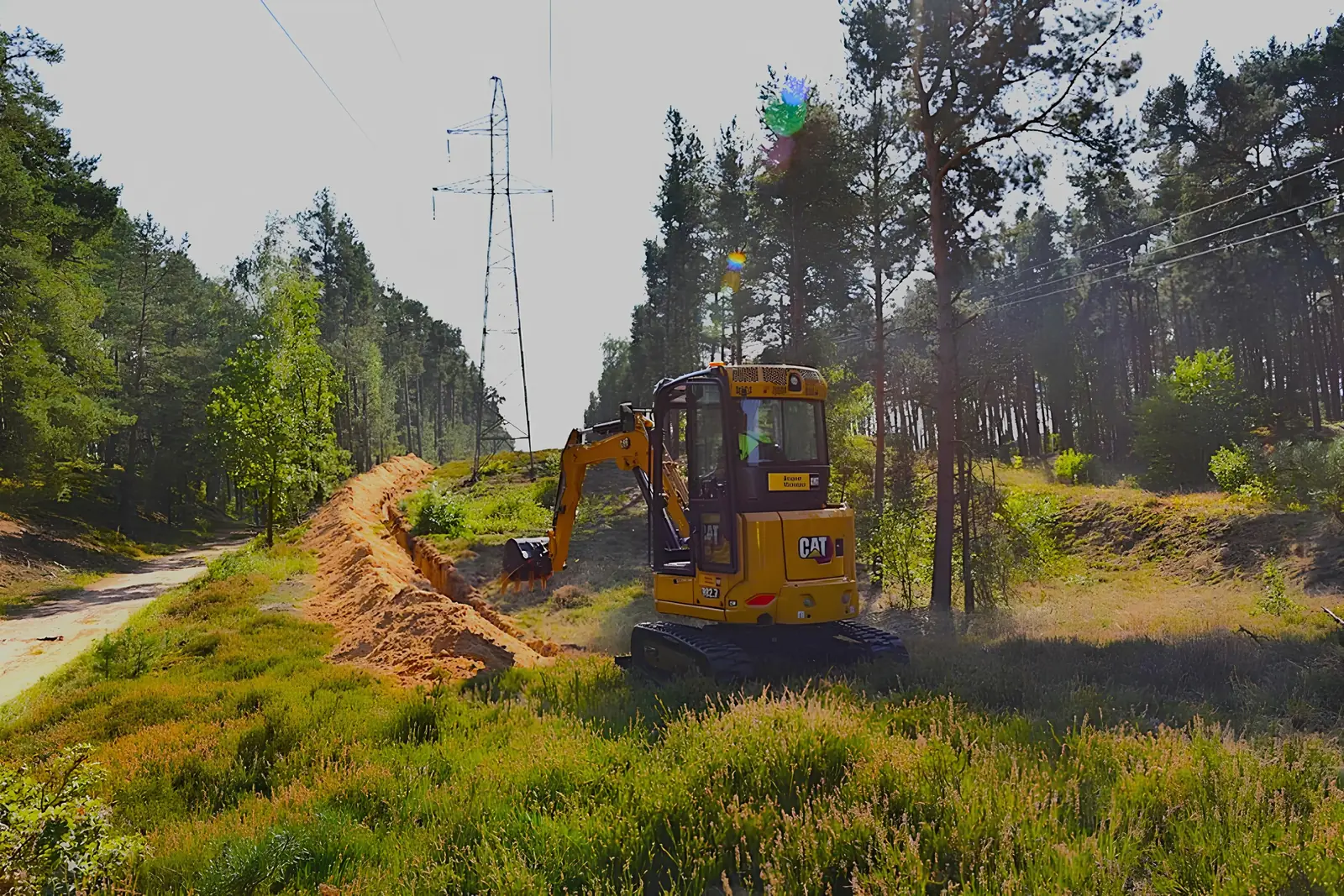
Undergrounding means replacing a section of overhead line (PL) with an underground cable line (KL). In practice a new cable line is built — often on a different route, along roads and streets — the supply is switched over to it, and then the conductors, insulators and poles of the old line are removed.
Undergrounding rarely stops at the line itself. The customer supply points are usually rebuilt with it: pole-mounted substations are replaced with packaged ones, tee-offs on poles with switching stations or substations with several line panels, and part of the 0.4 kV network also goes underground.
Reliability of supply
The main argument is reliability. Operators' service quality is assessed, among other things, by SAIDI (average duration of interruptions per customer per year) and SAIFI (average number of interruptions). The regulator, NEURC (НКРЕКП, the national energy regulator), tracks these indices, so operators have an interest in improving them.
An overhead line is vulnerable to events that a buried cable is practically immune to: falling trees and branches, conductors broken by wind, lightning flashovers, contact with machinery or birds. A single such event can trip the whole line and every customer beyond the fault until it is found and isolated. Replacing the most fault-prone sections with cable, combined with the ability to sectionalise the network, reduces both the number and duration of interruptions.
Storms, icing and lightning
Strong winds break trees and poles, while wet snow and icing sharply increase the load on conductors and structures. After a major storm, restoring overhead networks can take many days, because crews have to reach every damaged spot.
A buried cable is largely protected from these phenomena. That does not mean it never fails: it can be hit during third-party excavation, and a poorly installed joint can break down. But wind, ice and trees are no threat to it. An underground network is also better protected from damage by debris, although it is not protected against direct destruction.
Lines in forests, shelterbelts and settlements
An overhead line through a forest or along a shelterbelt needs regular corridor clearing. That is a cost for the operator and an intervention in the vegetation, and trees outside the corridor can still fall on the conductors. Once a line is undergrounded along a road, no corridor needs maintaining.
In settlements, safety and space come to the fore. The risk of touching a broken conductor or hitting a pole disappears, streets are freed of poles, and the overhead line protection zones that restrict construction on adjacent plots are replaced by the much narrower zone of a cable line. For new developments, cable supply is often the only acceptable option.
Drawbacks and limitations of cable lines
Undergrounding is not without drawbacks. When deciding, the operator considers:
- Construction cost — a cable line is usually more expensive than an overhead line of the same length, especially when the route has many HDD crossings and surface reinstatement.
- Fault location and repair — the location of a cable fault is found with special equipment, then excavated and a repair joint installed. This takes longer than replacing an insulator on a pole, although faults are rarer.
- Capacitive currents — a cable network has a much higher capacitance to earth than an overhead one. In isolated-neutral networks this increases the single-phase earth-fault current; with a large share of cables, the operator must provide capacitive current compensation or resistive neutral earthing and set the protection accordingly.
- Route approvals — a new route along roads needs approval from road owners, the owners of other utilities and local authorities.
- Workmanship — joint installation defects or sheath damage during laying can show up years later, so the jointers' skill and acceptance tests matter.
An intermediate solution is the PLZ — an overhead line with covered conductors (СІП-3 (SIP-3)). It is cheaper than a cable line, tolerates contact with branches better than a bare-conductor line and allows a narrower corridor, but it remains an overhead line and is vulnerable to icing and falling trees. Operators choose between a cable line and a PLZ depending on the section, the budget and network development plans.
Undergrounding, substations and the 0.4 kV network
A rural 10 kV line usually supplies a number of small substations from which 0.4 kV lines run to customers. Undergrounding the MV line therefore entails decisions about these points:
- Pole-mounted substations fed from the overhead line are replaced with packaged substations with a cable entry, or a short overhead section is kept with terminations on the end pole.
- Tee-offs, made on poles with disconnectors in an overhead line, are moved in a cable network to substations or switching stations with several line panels. This allows the tee-off to be supplied and the line to be sectionalised at the same time.
- The 0.4 kV network is often rebuilt at the same time — cable or SIP lines are built, distribution cabinets installed, and the old conductors and poles removed.
We describe how substations are built in the article Inside a 10(6)/0.4 kV transformer substation.
How undergrounding is done, step by step
- Design and approvals — the new route, connection points with the remaining network, substation and switching station locations, HDD locations; approvals from the owners of land, roads and other utilities.
- Preparation — survey setting-out of the route, excavation permits, traffic management plans, supply of cables and accessories.
- Building the cable line — trenches, HDD and pipe ramming under obstacles, laying cables in the ground and in ducts, installing substations.
- Fitting accessories — straight joints, terminations in substations and on poles where the cable connects to the remaining overhead line.
- Testing and switchover — after acceptance tests, the operator switches the supply to the new line.
- Removing the overhead line — taking down the conductors, removing insulators, poles and pole-mounted substations, and tidying the site.
- Documentation and acceptance — as-built survey, certificates of concealed works, test reports and handover of the network for operation.
The stages are detailed in the article From design to acceptance, and our approach to this work on the Overhead line undergrounding page.
See also
Read next
Overhead line undergrounding
Replacing MV and LV overhead lines with cable: building the cable line, HDD, cable cabinets, switching and dismantling the old line together with its poles.
Learn moreInside an MV/LV substation
Inside a 10(6)/0.4 kV transformer substation: pole-mounted, packaged, concrete and indoor types, 10 kV switchgear, transformer, 0.4 kV board and earthing.
Learn moreFrom design to acceptance — building a line
Stages of building an MV cable line: input data, design and approvals, preparation, trenching and HDD, installation, testing, documentation, acceptance.
Learn morePlanning to underground an MV line?
We will build the cable line with HDD crossings, install substations and remove the old overhead line — as general contractor or subcontractor.