
Knowledge · Technology
How horizontal directional drilling (HDD) works
A trenchless crossing under a road, railway or river is now a routine part of building cable lines. We show what happens underground during HDD.
A cable line rarely runs across open ground without obstacles. Along the route there are roads, driveways, drainage channels, rivers, railway tracks, paved footpaths, valuable trees and existing utilities. Digging up each of these would mean traffic restrictions, costly surface reinstatement and complex approvals. That is why a growing share of crossings is made by horizontal directional drilling — HDD. We explain how the technology works, when it is used and what its limitations are.
What horizontal directional drilling is
HDD is a trenchless method of laying ducts underground. A drilling rig on the surface drives rods with a drill head into the ground, and the operator can steer it — up, down and sideways — along the planned path. When the head reaches the exit point, the bore is enlarged and protective ducts are pulled into it, into which cables are later laid.
The process has three main stages:
- drilling the pilot bore;
- reaming the bore to the required diameter;
- pulling in the protective ducts.
Before the rig starts, the crossing is carefully prepared. The entry and exit points, the depth under the obstacle and the path are set from the topographic survey and the design. The location of existing utilities is confirmed — with hand-dug trial pits where needed — as is the soil type, which determines the choice of tools and the drilling fluid mix. The terms of the work, including minimum depth and clearances to structures, are agreed with the owner of the obstacle (road, water body, railway).
On the surface, only small areas for the rig and the exit point are needed, sometimes small pits. The road, tracks or river remain undisturbed.
Stage 1: the pilot bore
First a relatively narrow pilot bore is drilled. The drill head has a slanted blade. When the rods rotate, the head goes straight; when rotation is stopped in a certain position and the rods are pushed, the slanted blade deflects the head in the required direction. This is how the operator steers the path.
The head contains a sonde (transmitter) whose signal is picked up on the surface by a locator. The locator operator walks above the route, continuously reading the depth, pitch and position of the head and passing the data to the rig operator. This makes it possible to hold the design depth and bring the head out exactly at the exit point.
An HDD path is usually a gentle arc: from the entry point the head descends at an angle, passes under the obstacle at the required depth and rises to the exit point. The arc radii must respect the permissible bending of the rods and ducts.
The drilling progress is logged — the depth and position of the head at successive points. This data is needed for the as-built documentation, because it shows the actual position of the ducts under the obstacle, not just the entry and exit points.
Stage 2: reaming the bore
The pilot bore is too narrow for the ducts. Once the head comes out on the surface, it is removed and a reamer is fitted — a larger-diameter tool that is pulled back towards the rig while rotating.
Depending on the final diameter and the soil, reaming is done in one or several passes. The bore is usually enlarged to a diameter slightly larger than the duct or duct bundle to reduce friction and pulling force.
The reamer type is matched to the soil — some tools work better in clays, others in dense sands or gravelly soils. During reaming the operator monitors torque, pulling force and fluid pressure; a sudden rise in resistance indicates an obstruction or insufficient removal of cuttings from the bore.
Stage 3: pulling in the protective ducts
At the final stage a pulling head with the ducts is attached to the reamer through a swivel (which does not transmit rotation), and the rig pulls them through the bore. For MV cable lines polyethylene ducts are most often pulled in — singly or as a bundle, for example three ducts for three single-core cables plus an extra duct for a fibre-optic cable.
Before pulling, the ducts are welded or joined to the full length of the crossing and laid out on the surface on the exit side. After pulling, the duct ends are sealed against contamination, and the cables are later pulled into them.
When choosing ducts, not only the inner diameter matters but also the wall thickness and tensile strength: during pulling the duct is subjected to high forces, and afterwards it must withstand soil pressure and traffic loads. That is why HDD uses ducts designed for trenchless technologies, with parameters as per the design.
The role of drilling fluid
During drilling and reaming, drilling fluid is pumped through the rods — most often a mixture of water and bentonite, in difficult soils also with polymer additives. It comes out through the nozzles of the head and reamer and:
- stabilises the bore walls by forming a thin cake on them;
- carries cuttings — the drilled soil — to the surface;
- cools and lubricates the tools and rods;
- reduces friction when pulling in the ducts.
Spent fluid is collected in pits or tanks at the entry and exit points and then taken away. It is important to control the fluid pressure to prevent it from breaking out to the surface, for example into the bed of a water body.
When HDD is used
- under national and local roads and streets — when the owner will not approve opening the surface or it would require closing the road;
- under railway and tram tracks;
- under rivers, canals and drainage systems;
- under driveways, footpaths and hard-surfaced areas;
- near valuable trees and in green areas, to avoid damaging the root system;
- where utilities are densely packed and an open trench would be risky.
Because the surface stays intact, HDD avoids long traffic restrictions and costly reinstatement of the road pavement. For the road owner this means less risk of settlement where an excavation used to be, and for residents a shorter disruption.
HDD or pipe ramming — what is the difference
| Feature | HDD | Pipe ramming (thrust boring) |
|---|---|---|
| Path steering | yes, during drilling | no — the direction is set at the start |
| Typical length | from several tens to several hundred metres, depending on the rig and soil | short sections, e.g. under a carriageway |
| Route shape | an arc; obstacles can be bypassed | straight |
| Pits | often only small pits; the rig enters from the surface | launch and reception pits |
| Drilling fluid | yes | depends on the technology, often without fluid |
Pipe ramming with a pneumatic piercing tool or a hydraulic rig is well suited to short, straight crossings. HDD is more versatile and can tackle longer and deeper obstacles.
Limitations and risks
- Soil — clays, loams and sands are best suited. Gravel with boulders, construction debris and rock make drilling harder or require special tools.
- Existing utilities — their location must be established precisely from the survey and trial pits; the head must pass at a safe distance from other cables and pipelines.
- Length and diameter — the limits depend on the rig's pulling force, the soil and the route geometry.
- Surface space — room is needed for the rig, the fluid equipment and laying out the ducts along the full length of the crossing.
- Heat dissipation — a cable in a duct deep under an obstacle cools less well than in a trench; the designer takes this into account when choosing the cable cross-section and duct diameter.
That is why HDD is designed and carried out on the basis of an up-to-date survey, approvals from the obstacle owners and soil data, and the actual path is recorded in the as-built documentation.
HDD in our work
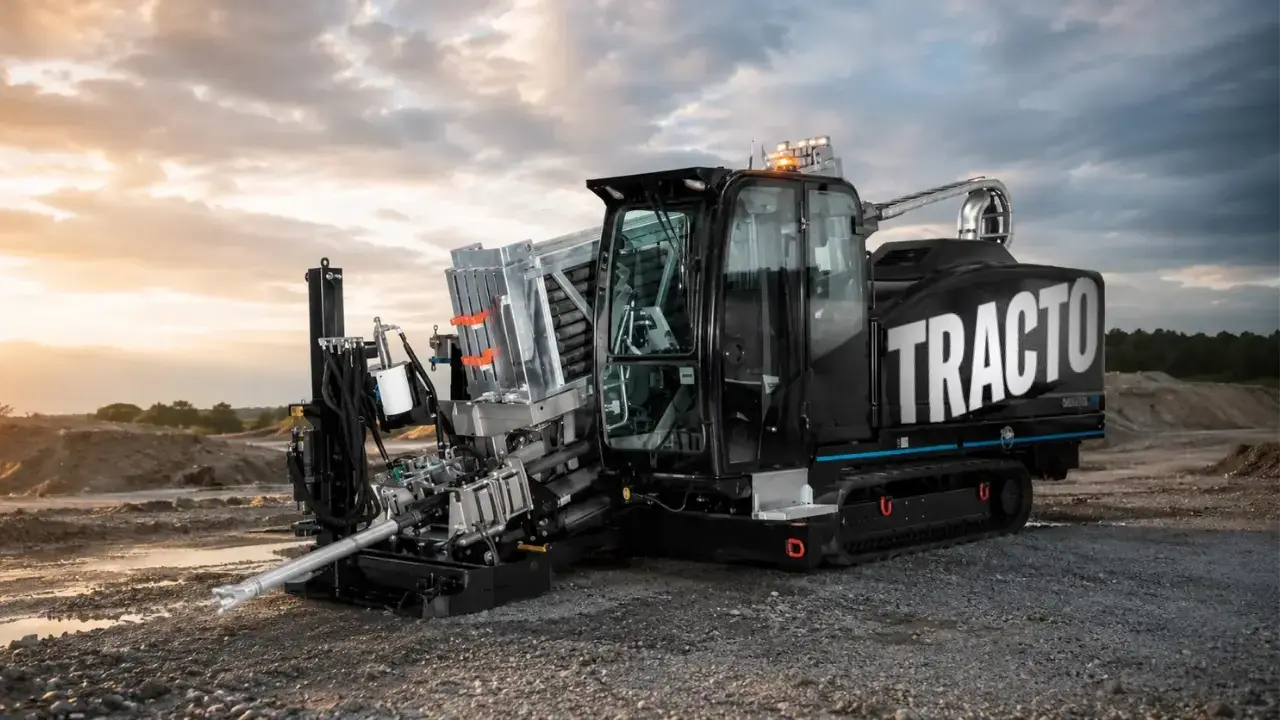
We carry out HDD with our own GRUNDODRILL 15 XPT drilling rig (Tracto Technik). Together with excavators for the pits and a truck with a loader crane for transporting ducts and machinery, it forms a set that lets us make crossings without bringing in outside drilling companies and coordinate them more easily with other work on the route.
We do HDD as part of our own cable line construction and as a separate service for other contractors — including for fibre-optic duct systems. Details are on the Horizontal directional drilling (HDD) page, and the machinery in the Equipment section.
See also
Read next
Horizontal directional drilling
HDD and pipe ramming under roads, railways and watercourses — protective ducts for MV, LV and fibre cables. Our own Tracto GRUNDODRILL rig.
Learn moreFibre-optic ducts
Cable duct construction for fibre: HDPE ducts and microducts, cable chambers, HDD under roads and railways. Linear works across Ukraine.
Learn moreFrom design to acceptance — building a line
Stages of building an MV cable line: input data, design and approvals, preparation, trenching and HDD, installation, testing, documentation, acceptance.
Learn moreNeed an HDD crossing under a road or river?
We will carry out HDD and pull in protective ducts — as part of building a line or as a separate service. Send us the crossing locations and lengths.